
Index
transform_EMN: Transformation of the automotive and supplier industry in the Nuremberg Metropolitan Region
Around 100,000 employees in the Nuremberg Metropolitan Region work for suppliers of the automotive industry. Many of the jobs depend on the combustion engine and are endangered by the transformation of the industry. The large-scale project transform_EMN with a volume of 6.6 million euros supports companies, among other things, in the development of new business ideas and technology transfer.
The FAPS is responsible for setting up and operating the innovation platform “Transformation-oriented Production – Sustainable and Digital Manufacturing”. Participating SMEs from the automotive and supplier industry are given the opportunity to test technologies for digital, energy-efficient and climate-friendly production, to develop these further together with scientists from the participating research institution, and to demonstrate the production capabilities gained. Based on these experiences, the chair develops and disseminates a variety of qualification offers and consulting measures.
In the context of the digitalization of production, the chair is developing needs-based solutions for the local supplier industry. In order to achieve a cost-efficient and low-threshold entry, the use of open-source software and modern cloud technologies is to be promoted in particular. The focus will be on the derivation of suitable data models, the investigation of state-of-the-art communication technologies and the demonstration of artificial intelligence methods. In the context of systematic intelligence enhancement, the knowledge gained will be demonstrated in practice on innovative production systems.
The second in-depth topic is the conversion to sustainable and CO2-neutral production. The design of sustainable and intelligent energy distribution architectures for production sites as well as the integration of decentralized, regenerative generators and storage systems both from a hardware perspective and the intelligent coupling and transfer to an “Industrie 4.0”-compliant energy management play an essential role here. Efficient direct current grids should be mentioned as a special solution concept.
DC|hyPASim – Digital planning and simulation of hybrid AC/DC power grids in automated production plants
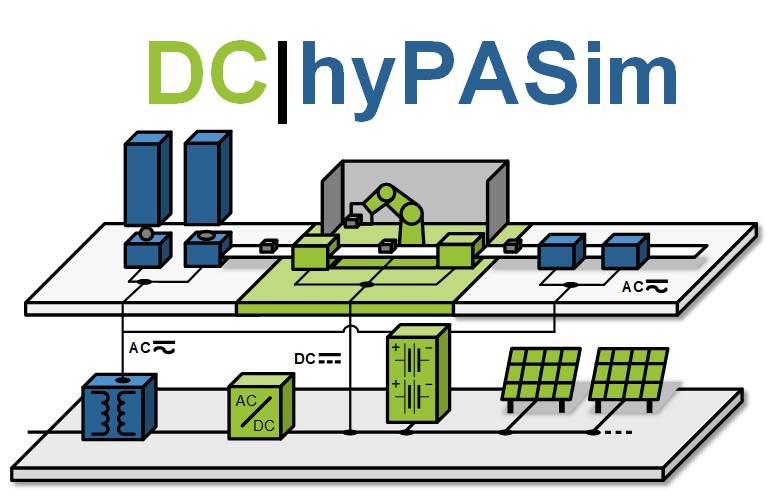
The DC|hyPASim project aims to identify and harness unused energy saving potential in the manufacturing industry. In the course of this, technical measures to control the natural fluctuation of renewable energy sources will be evaluated in the context of future energy supply. Overall, investment costs will be reduced (by eliminating a large number of power supply units and converters), energy consumption will be lowered (by reducing power conversion processes), companies’ ability to innovate will be strengthened (by means of new products) and a path to CO2-neutral production will be shown. To achieve this goal, DC grids or hybrid structures consisting of DC and AC grids are used, with which, for example, regenerative energy or recuperation energy from electric drives can be exchanged or stored efficiently and intelligently.
In the project digital models will be used to test how DC branches can be linked to industrial networks in a time- and cost-efficient manner. The usable result will be a digital planning landscape and a prototype implementation of the concept. The feasibility of the new supply concept will be tested by means of a demonstrator system to be developed for decentralised DC grid branches with generators, storage units and consumers.
DC|hyPASim is funded as part of the AiF call for proposals “Leading Technologies for the Energy Transition”.
Furthermore, the project advisory committee consists of more than 30 partners from industry and renowned research associations.
Addressed research focus areas
- Dimensioning of hybrid AC/DC energy grids with generators, storage units and consumers based on an own DC demonstrator
- Planning landscape with digital twin
- Linking the electrical system behaviour (energy level) with the digital models of the production facilities (process level)
- Holistic protection and control concept for hybrid network architectures
- Software-based economic assessment of such networks
AI4CO2Opt: deep reinforcement learning methods for the reduction of CO2 emissions through the energetic optimization of production control

The research project AI4CO2Opt addresses the minimization of energy consumption and consequently CO2 emissions while at the same time optimizing production control. Through the combination of energetic and event-discrete simulation models as well as deeper reinforcement learning processes, different production scenarios can be derived at runtime for multivariate and dynamic optimization goals and imported into production. Furthermore, as part of a holistic approach to energy consumption, the simulation and machine learning models developed are used to enable production-related detection and classification of abnormal energy consumption at process and plant level. In order to meet current and future economic and legislative requirements for the traceability of CO2 emissions, a consistent CO2 traceability system for all system components is being designed and implemented as a prototype.
The AI4CO2Opt project will start on April 1st, 2022 and will be funded by the Bavarian State Ministry for Science and Art (stmwk) for a period of 3 years. It can be assigned to the “Digitalization in the Energy Sector” track in the “R&D Program Information and Communication Technology Bavaria” program.
DualSys: Universal production system optimization by combined learning systems

Machine learning techniques are increasingly used in monitoring and optimizing industrial production due to recent advances in computing capacities as well as the spread of developer-friendly software libraries. Essential challenges such as high initial manual effort as well as the general data quality remain as obstacles to widespread use.
DualSys strives to replace labor-intensive, human-related activities such as the annotation of process data and the selection of suitable preprocessing methods or to relocate them to later project phases. Furthermore, the special potentials of unsupervised and self-monitored learning processes to solve the problem of the subjective ground truth are examined. The aim is a holistic approach that spans industrial manufacturing processes as well as production systems in the form of application scenarios for process optimization, process monitoring and the prediction of product quality.
With the help of the developed methodology as well as developed procedures and software libraries, a return on investment can be achieved even in previously unprofitable use cases and companies can be enabled to use ML across the board.
ConSensE – Advanced Systems Configuration for Complexity-Reduced Sensor-Driven Development of Production Systems in the Digital Age
Manufacturing companies see far-reaching opportunities in digitalization. However, they are confronted with the specific question of what added value the expansion of existing machines and plants with new technologies promises in order to exploit their innovation potential. It is important to increase the flexibility and adaptability of existing machines and systems with regard to products to be manufactured and digital business models. The large number and complexity of available technologies, the lack of necessary competence development and design aids for human-technology interaction, and difficulties in estimating the economic viability of sensor-based applications often lead small and medium-sized enterprises (SMEs) in particular to postpone the urgent upgrading of their machines and plants.
The objective of the ConSensE research project is therefore to reduce the complexity of plant development and extension in the area of available sensor technology and the associated technical diversity. This goal will be achieved by developing an assistance system that supports users (such as plant operators and manufacturers as well as sensor manufacturers) in the selection and integration of suitable sensors for existing and new production plants, reduces set-up times and lays the foundation for the development of digital services and business models. Above all, SMEs are supported by the assistance system in the selection of sensors for the retrofitting of existing production systems and are shown possible potential for new business models and services at an early stage. The configurator is intended to enable users of the production systems to identify user-centric requirements that go beyond mere functional fulfillment as early as the planning phase. Furthermore, other stakeholders such as plant or sensor developers can use the tool to develop and offer data-driven services as a complement to their hardware product.
SiC4DC – Edge-Cloud-Energy-Management for DC-powered automation systems with SiC-based power electronics
Increasing digitization and automation enable more efficient processes, perfected quality and optimized use of resources, thereby constantly improving the competitiveness of manufacturing companies in Germany as a high-wage location. However, the increasing use of electrical drive technology and the spread of electronics and sensor technology are tending to lead to a higher demand for electrical energy. For example, the industry and manufacturing sector consume about half of the electrical energy in Germany.
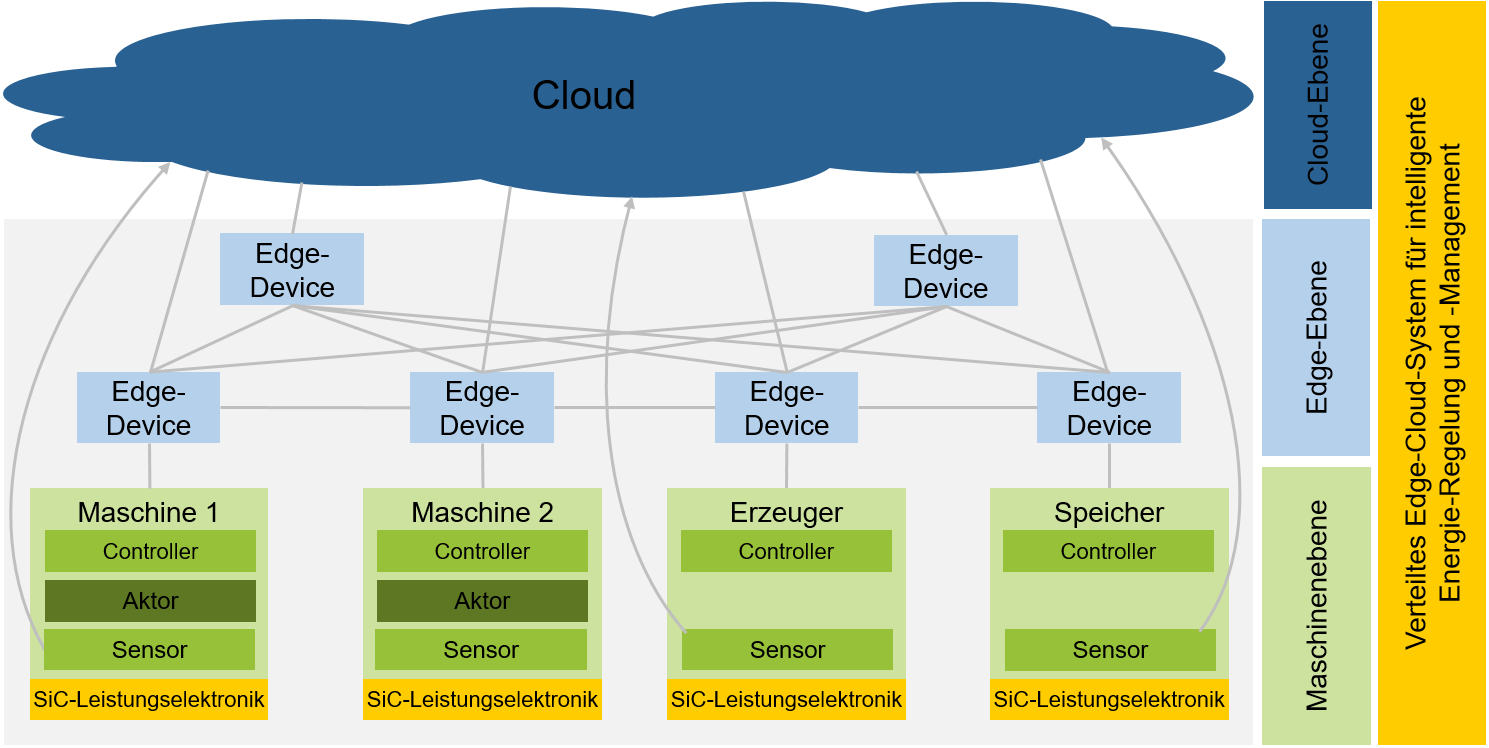
The SiC4DC research project is dedicated to the energetic optimization of automated production systems in order to reduce the energy demand and CO2 emissions of the entire system. In cooperation with the Fraunhofer Institute for Integrated Systems and Device Technology IISB and the two associated partners Siemens and Mercedes-Benz, the consortium, under the direction of the Institute for Factory Automation and Production Systems (FAPS), is researching the following topics in the project:
- Application of SiC-based power electronics in automation technology
- Use of hybrid AC/DC grids and renewable energies
- Fine granular IoT sensor network for real-time detection of energy wastage
- Decentralized distributed energy management based on self-learning processes in edge-cloud systems
- Internet-based planning, configuration and simulation systems for estimating potential and costs
In the pre-project phase, in order to examine the components of the solution concept, including the development of a comprehensive implementation plan as well as the execution of a potential analysis, in order to implement the SiC4DC concept in the subsequent phase of the innovation competition, SiC4DC is funded by the Federal Ministry of Education and Research (BMBF) with approx. 250,000 € over a period of 9 months.
PRODISYS – engineering of service-based industry platforms
Industry 4.0 requires a radical rethinking in manufacturing companies. Processes that have previously been designed separately
are interlinked, remodeled and optimally coordinated through digital technologies. How can this be achieved in practice? For
this purpose, business informatics has developed the concept of Service Systems in which value creation is modeled as a result
of the collaboration of many individual stakeholders.
The design of production-related service systems is the focus of the new research project PRODISYS, in which the FAU was awarded
the Chair for Business Informatics, in particular Innovation and Value Creation (WI1), and the Chair for production automation
and production systems (FAPS). PRODISYS is supported by the Federal Ministry of Education And Research (BMBF) with a total project
volume of EUR 3.0 million with EUR 2.25 million. Other parties in the Project are fortiss GmbH in Munich as coordinator and the HHL
Leipzig Graduate School of Management with the Center for Leading Innovation & Cooperation (CLIC) in particular and Audi, Continental,
Crossbar, SAP and Xenon.
Over a period of three years, the consortium partners in the project will develop new approaches to the context of the digitized value
creation and to check it in practice by means of piloting. The research project has started on 01.07.2017.
We are looking forward to the project and research work in the coming three years and the cooperation with the project partners.